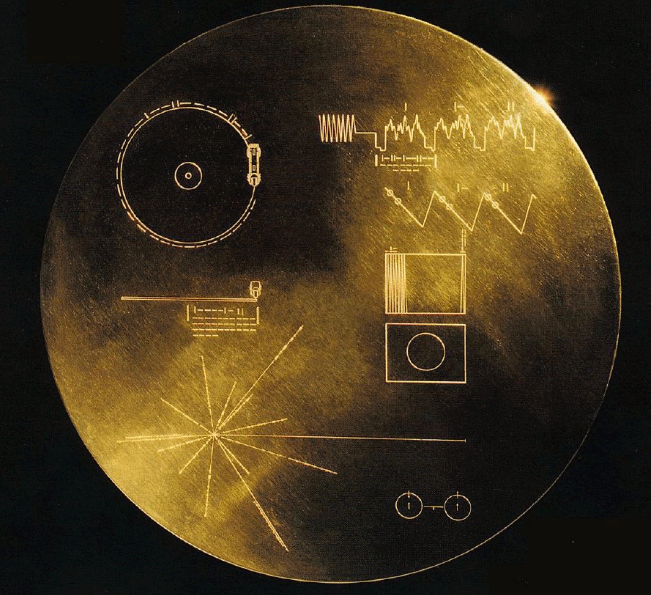
The Golden Record; a gift to the aliens
On September 5th, 1977, NASA launched Voyager 1 at Cape Canaveral, Florida. (The 49th anniversary was just 9 days ago.)
The goal was to explore Jupiter and Saturn, including their rings and large moons. But after nailing these planetary flybys, they extended its mission to the “Voyager Interstellar Mission” to enter interstellar space for the first time. And they did it!
What now?
One thing that remains valuable on the probe is something that encapsulates the diversity and culture of our entire Earth. It was created for one reason: that someday, by some vanishingly small chance, interstellar lifeforms may find and understand it.
It’s called the Voyager Golden Record.
The 12-inch phonograph disc contains roughly 2 hours of audio, including greetings in 55 different languages, wind, rain, thunder, a baby crying, a diverse selection of music, and encoded analog images depicting human anatomy and the world.
But how can we even start to communicate with a life form that developed completely separately from us? NASA had to invent a code that anyone in the universe might be able to decipher. The face of the record includes a diagram explaining how to decode the audio and images, with the unit of measurement in hydrogen atoms; the most common element in the universe. It also has a diagram of where Earth is relative to our solar system’s sun.
Even though the odds that aliens will find and understand it are basically zero, it was developed during the Cold War, and brought many together. It bypassed political divisions of the Cold War, and presented the Earth not as a collection of warring nations, but as a single, fragile world sharing the human story of music, art, science, and nature.
I think it’s so cool that what takes up the most audio-time on the precious disc is music. Of all things, music is the form of culture that ties us together. Music transcends the boundaries of religion, race, language, and (hopefully) planet 😉. Everyone can enjoy music.
It’s fun knowing that somewhere in the great universe is a tiny fingerprint of humanity waiting to be discovered.
Pretty cool, right?