Skyscrapers
In downtown Dubai there is a building called Burj Khalifa. It holds the current Guinness World Record for the tallest building on the planet. The building is 2,717 feet tall.
That’s tall.
It’s an architectural work of wonder, built to withstand rain, wind, and even its own massive weight.
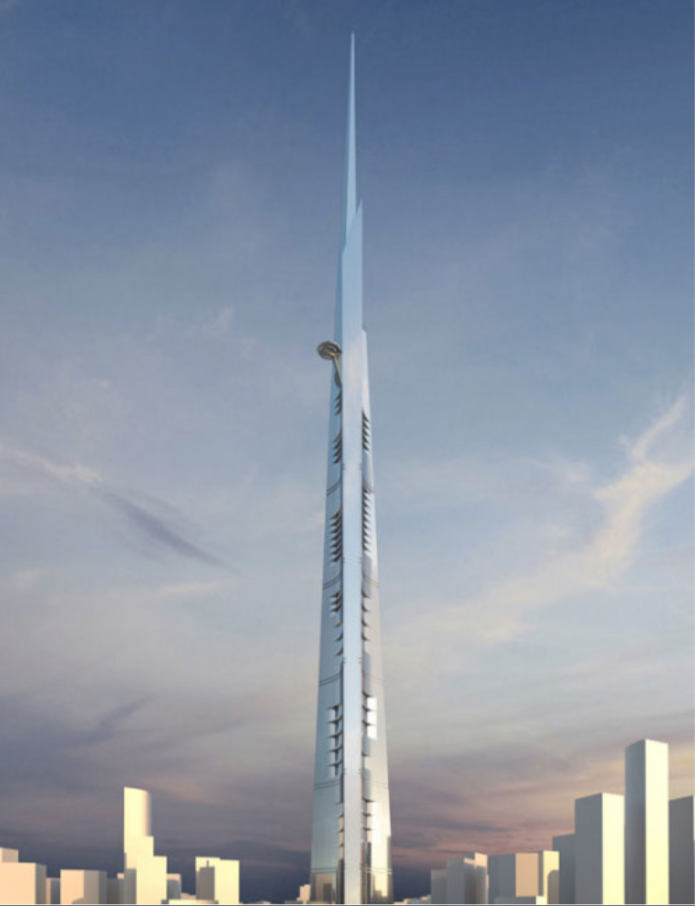
But in the background, Adrian Smith, the same architect who built the Burj Khalifa, is working on a new tower in Saudi Arabia. It’s called the Jeddah Tower.
The project began in 2013, went on a long hiatus in 2018, and officially restarted in January of 2025. As of right now, it’s on its 113th floor (1,490 feet) and rising a few feet every day.
It’s blueprint is really cool:
- It was designed with a hexagonal core, supported by three aerodynamically-tapered wings. This triangular footprint deflects wind from all directions, instead of taking it straight on like square buildings.
- It will have 7 different segments featuring a Four Seasons hotel, luxury condominiums, and the world’s highest circular terrace observation deck.
- When you reach a height this great, transportation between floors becomes an issue. You couldn’t efficiently stop at every floor to pick up passengers, right? The Jeddah Economic Company has teamed up with elevator manufacturer KONE to design a “vertical subway network”. Instead of traditional elevators servicing the whole building, high-capacity “express shuttles” shoot passengers directly to three "Sky Lobbies" on floors 33, 65, and 125. If you live on floor 40, you’d take the express shuttle to floor 33, step out, then take a “local elevator” that serves only floors 33 through 45.
- The observation deck will be a 98-foot-diameter terrace located roughly 2,067 feet off the ground. I wanna’ go there some day!
- At this height, traditional steel elevator cables become a major hazard—they’d snap under their own weight. Instead, the shuttles use a groundbreaking technology called UltraRope; a carbon-fiber strip that is 7 times lighter but just as strong. This makes vertical travel energy efficient and structurally safe.
- Since the tower is so tall, swaying is inevitable. Instead of rigidly combatting this sway, they’re leaning into it (no pun intended). At the top, it will be able to bend around 6.5 feet!
- The total cost of the tower itself is around $1.2 billion. How will they make their money back? Apparently through a mix of luxury real estate, premium hotels, and tourist attractions.
It’s scheduled to be complete in August of 2028. It will be 3,281 feet tall, making it the first building to cross the 1-kilometer mark. What a world!